Insurance AI Is No Longer a Pilot. The Hiring Has Changed Too. | Cavehill Consulting
Insurance AI Is No Longer a Pilot. The Hiring Has Changed Too. | Cavehill Consulting
For the last three years, the question most insurers were asking about AI was whether to invest. That question has been answered. The question now is whether they have the people to make it work.
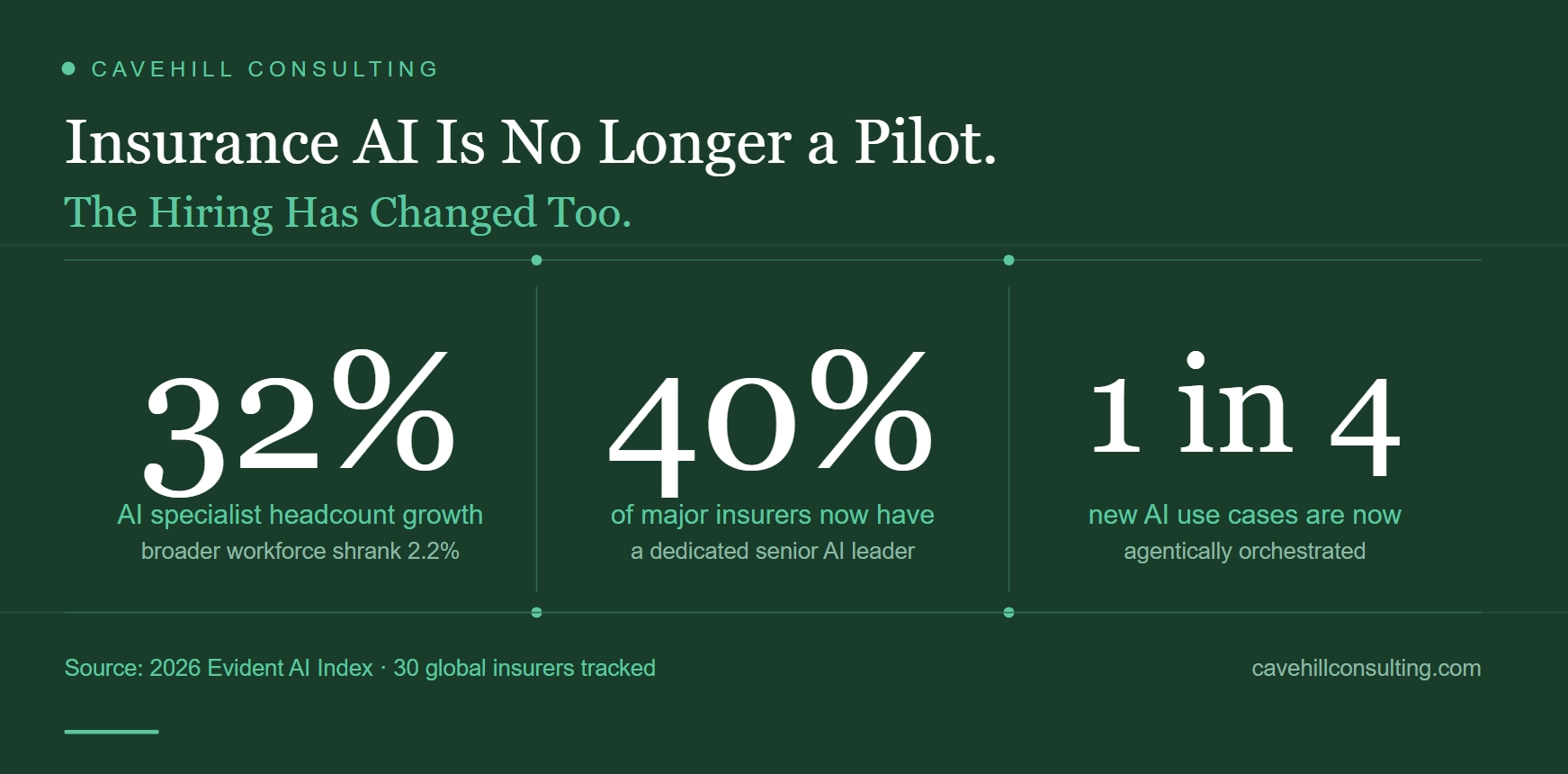
The 2026 Evident AI Index tracked 30 of the world's largest insurers. AI specialist headcount across those firms grew 32% over the past year. The broader insurance workforce contracted by 2.2% over the same period. Carriers are not hiring more people overall. They are hiring different ones, and they are restructuring quickly to do it.
The governance gap became impossible to ignore
Nearly 40% of the insurers in the index now have a senior leader with dedicated responsibility for AI. Most of those appointments happened in the last 12 months.
That shift matters. For years, AI accountability sat inside existing functions — the Chief Data Officer, the CTO, the Head of Analytics. It was owned by whoever had built the first use cases. As those use cases moved from experimentation into production, the governance question moved with them, and it outgrew its original home.
Boards want oversight. Regulators want audit trails. Business units want someone accountable when a model behaves unexpectedly. A CDO running a data platform while also governing AI risk across the enterprise is doing two jobs that have become too distinct to combine.
The standalone AI leader role — variously titled Chief AI Officer, Head of AI Strategy, or VP of AI Governance — is the market's answer to that problem.
The pace of deployment has changed what the role requires
One in four newly disclosed AI use cases at the insurers tracked now shows evidence of agentic orchestration. Six months ago, it was one in twenty.
Agentic AI — systems that take action, coordinate multi-step processes, and make decisions with limited human intervention — changes the risk profile of what carriers are deploying. It also changes what a governance function needs to do.
Reviewing a static model is one thing. Governing an AI system that is actively submitting, triaging, and routing claims in real time is another. The skills required are different: less focused on data infrastructure, more focused on operational risk, human oversight frameworks, and the kind of decision-audit capability that regulators expect.
The people who can operate at that level are not generalists. They came from a narrow set of backgrounds — AI product management in financial services, risk and compliance functions that built out model governance frameworks post-GDPR, or technical delivery roles that gave them enough depth to understand what they are actually governing.
What this means for carriers hiring now
The market for AI leadership in insurance is moving from demand signals to active hiring. The candidates who can step into a Head of AI or AI Governance mandate at a carrier or managing agent are a small population, and several of them are not actively looking.
There are three things most firms get wrong when they approach this hire.
They scope it too narrowly. The brief starts as a technical role — someone to own the model registry, manage vendor assessments, run the RAI framework. By the time the hiring manager has spoken to two or three candidates, the brief has expanded to include board reporting, regulatory engagement, and change management. That scope should be in the job description from the start, because it determines where you source.
They look in the wrong places. The strongest candidates for this function in insurance right now are not coming from pure technology backgrounds. They are coming from the intersection of delivery and governance — people who have built something in production and then had to answer for it. Financial services more broadly is producing them, but insurance-specific experience commands a significant premium.
They move too slowly. The AI Governance Specialist category appreciated 47% in salary between 2022 and 2026 across the roles we benchmarked. That rate of appreciation reflects genuine scarcity. Firms that run a standard three-stage process with a two-week gap between rounds are losing candidates to organisations that have recognised the market they are operating in.
The candidate perspective
For technologists and change professionals already working inside insurance, the shift creates real opportunity.
The AI leadership roles being built now are not replacements for existing functions. They are net new mandates with senior reporting lines and, in most cases, no established playbook. That combination — seniority, scope, and genuine ambiguity about what good looks like — is rare. It tends to attract people who want to define a function rather than inherit one.
If your background sits across AI or data product ownership, model governance, or delivery leadership in a regulated environment, and you have been watching this market develop from inside it, the next 12 months are the right time to explore what is being built.
Cavehill Consulting places Technology and Change professionals across the London Market, UK carriers, and Ireland. We work on AI leadership, AI governance, and data strategy appointments at Director level and above. If you are hiring for this function or want to understand the candidate market, get in touch.
Recent News
Our Latest Stories.