The M&A Integration Problem No P&C Acquirer Is Prepared For | Cavehill Consulting
The M&A Integration Problem No P&C Acquirer Is Prepared For | Cavehill Consulting
The M&A Integration Problem No P&C Acquirer Is Prepared For
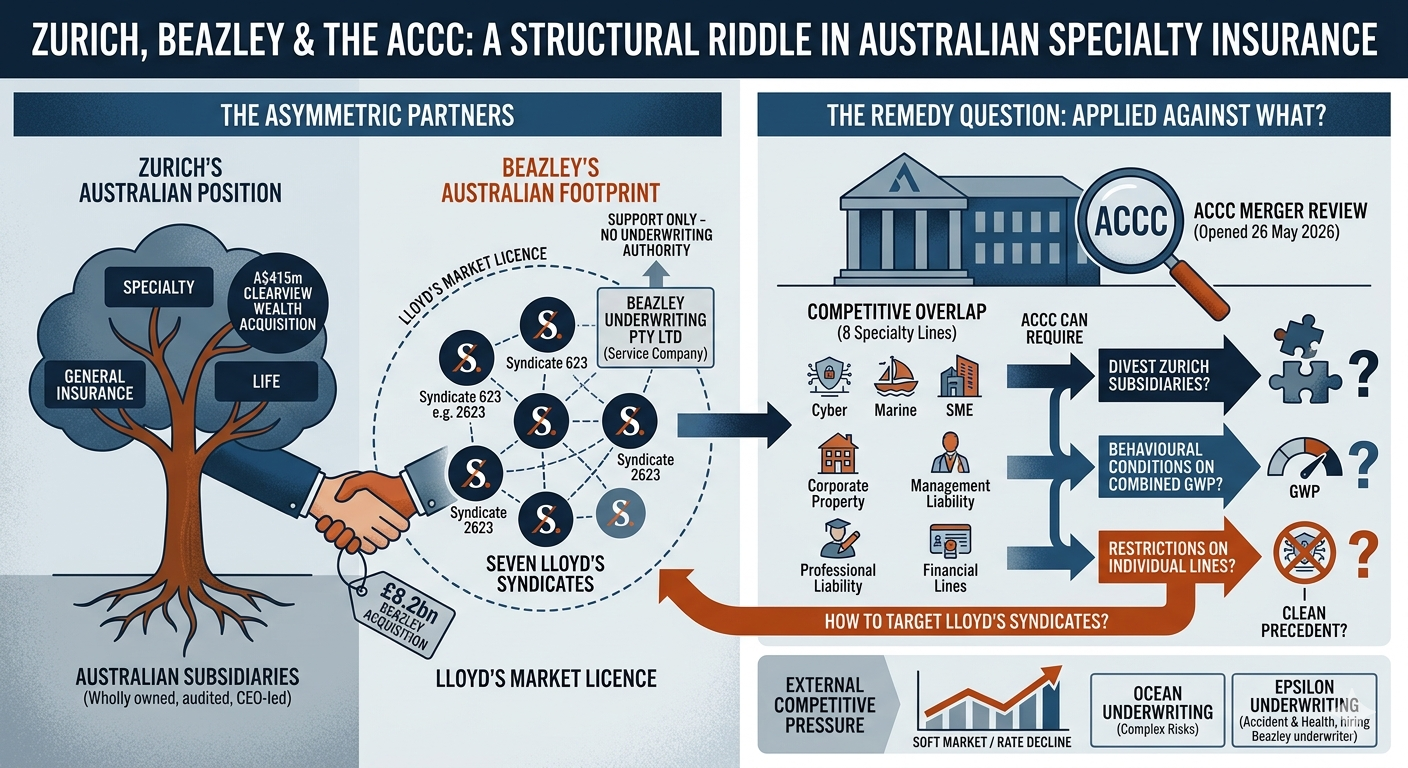
There is more than $35 billion of M&A activity in specialty insurance from the past twelve months. Zurich acquiring Beazley. Starr acquiring IQUW. Sompo acquiring Aspen. Radian acquiring Inigo. In every case, a P&C-heritage acquirer has bought a specialty book — and in every case, the integration team will encounter the same architectural problem that generalist M&A advisors consistently fail to anticipate.
The problem is not cultural. It is structural.
The specialty/P&C inversion
P&C insurance and specialty insurance are not the same product in different wrappers. They have fundamentally different data architectures, different placement workflows, and different underwriting logic. A P&C policy is a standardised product sold at volume. A specialty risk is individually negotiated, structured across multiple underwriters, and placed through a broker workflow that does not exist in P&C at all.
Most modern policy administration platforms — Guidewire, Duck Creek, and their equivalents — were built for P&C. They handle P&C risk correctly. They handle specialty risk by approximation: custom fields, workaround configurations, and functionality that has been bolted on rather than designed in.
When a P&C carrier acquires a specialty book and attempts to run the acquired business on its existing technology platform, the mismatch surfaces immediately. The underwriting workflow does not map. The data model does not capture the fields that Lloyd's CDR requires. The placement process — broker slip, line structure, syndicate participation — has no equivalent in the P&C architecture.
This is the inversion problem: P&C architecture inverts the specialty workflow rather than accommodating it.
Why integration teams miss it
The integration playbook for a P&C acquirer buying a specialty book typically focuses on legal entity consolidation, reinsurance programme harmonisation, and financial reporting alignment. These are legitimate priorities. They are also the easy ones.
Technology integration is treated as a later-stage workstream: rationalise platforms, migrate data, retire legacy systems. The sequence seems logical. The problem is that the architectural decision — which platform governs the integrated business, and how specialty risk logic is accommodated within it — is being made implicitly by the sequence itself. By the time the technology workstream begins in earnest, the organisational structure has been set around an assumption about how the platforms will align. Reversing the architecture at that point is a multi-year remediation project.
The firms that avoid this problem make the architectural decision first — before the integration governance is set, before the platform rationalisation roadmap is drafted, and before the specialty underwriting team is told which system they will be working in.
The CDR dimension
Blueprint Two's delay has added a specific complication to every active M&A integration in the specialty market. The Core Data Record requirement — capture placement data at source, in a structured ACORD-compliant format, at the point of bind — applies to the acquired business regardless of which platform it runs on post-integration.
A P&C acquirer inheriting a specialty book that is already working toward CDR-compatible architecture faces a choice: preserve and extend that architecture through the integration, or absorb the specialty business into P&C infrastructure and rebuild the CDR capability from scratch.
The first option is architecturally straightforward and commercially protective. The second is faster to execute on paper and significantly more expensive in practice — because CDR capability built into a P&C platform for a specialty workflow is, structurally, the inversion problem applied to data architecture.
The pre-close window
The window in which these decisions can be made correctly is pre-close. Post-close, the integration governance is set, the organisational structure is in place, and the technology decisions are being made under operational pressure rather than architectural logic.
Pre-close is when the acquiring team should be asking: what is the acquired business's CDR architecture, how does it map to our platform, and what do we need to preserve through the integration to avoid rebuilding it at cost?
That conversation requires someone in the room who understands both the specialty underwriting architecture and the integration risk simultaneously. It is not a question a generalist integration team can answer without specialist input — and most do not know to ask it until the problem is already embedded in the programme.
If you are working through a specialty acquisition and want a diagnostic conversation on the architectural risk, contact Grant.Bodie@CavehillConsulting.com.
Recent News
Our Latest Stories.